
BPSC TRE Cut Off: Previous Year Marks and 2026 Trend
BPSC TRE Cut Off: Previous Year Marks and 2026 Trend
Two numbers get confused in every TRE discussion, and the confusion costs people their planning. Qualifying marks are the minimum you need to be counted. The cut off is the mark at which selection actually closed in your subject, level, category and district. They are usually far apart.
This page keeps them in separate sections on purpose, gives previous cycle figures where they are available, and is honest about where those figures came from.
A note on sources before you read the tables
BPSC publishes cut off information through its own result notices. The category and subject wise tables reproduced across coaching websites are secondary compilations of those notices, and they do not always agree with each other.
Everything in the previous year tables below is single source, verify on bpsc.bihar.gov.in. Use them for the shape of the trend, not as a target you plan your life around. Where ExamAtlas has cross checked figures against the commission's own notices, they sit on the verified cut off data page.
Section one: qualifying marks, which are official
The 32% slab applies to Bihar domicile women and Divyang candidates. You also need 9 marks out of 30 in the qualifying language paper, which is a separate gate.
Clearing the qualifying mark puts you in the merit list. It does not select you. In a subject with 40 posts and 900 qualified candidates, the qualifying mark is irrelevant to the outcome.
Section two: actual cut off, which is where selection happens
The cut off moves with four variables at once: level, subject, category and district. That is why a single headline cut off for TRE does not exist, and any site giving you one number is making it up.
TRE 3.0, 2024 cycle, sample figures
Single source, verify on bpsc.bihar.gov.in. Blank cells mean that combination was not in the compilation we could access, not that the cut off was zero.
TRE 1.0, 2023 cycle, sample figures
Single source, verify on bpsc.bihar.gov.in.
Four things these tables actually tell you
1. The number 39 keeps appearing, and it is not a coincidence
Look at how often SC and ST cut offs land exactly on 39. That is the qualifying floor for those categories, and when a cut off equals the qualifying mark it means the same thing every time: in that subject and category, the posts were not exhausted by qualified candidates.
If you are an SC or ST candidate in a subject where this happened, your real target is the qualifying mark, not a competitive score. That changes how you should plan entirely.
2. Subject matters more than level
TGT Mathematics at 102 for UR and PGT English at 49 for UR came out of the same recruitment. The gap is not about difficulty of the paper. It is about how many people with that degree applied against how many posts existed.
Languages and commerce subjects have historically closed lower. Mathematics, Social Science and the popular science subjects have closed high.
3. The female cut off is usually lower, but not always
PGT Mathematics in TRE 3.0 shows 83 for UR and 66 for UR female, a 17 mark gap. PGT Hindi shows 88 for both. Where fewer women applied in a subject, the horizontal quota pulls the line down sharply. Where participation was high, it barely moves.
4. Cut offs rose between TRE 1.0 and TRE 3.0
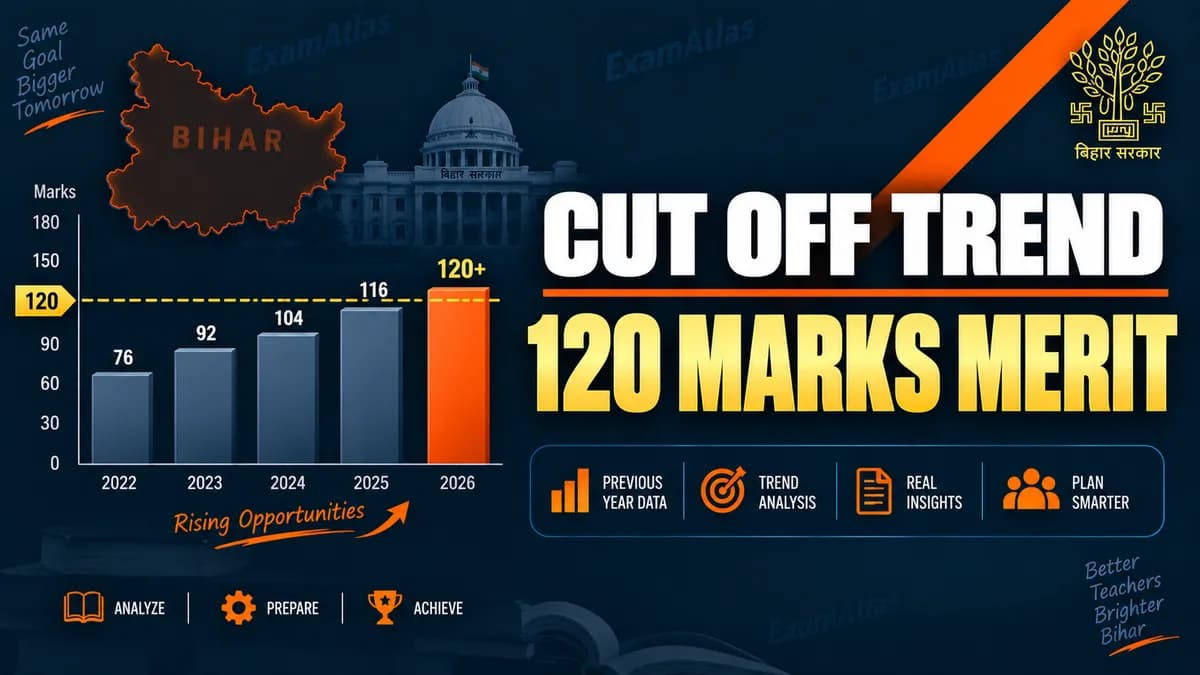
Compare TGT Mathematics at 72 in 2023 and 102 in 2024, or PRT General at 67 and 81. The candidate pool got larger and better prepared across cycles, which is what happens when a state runs three teacher recruitments in two years.
What this means for TRE 4.0
BPSC has not announced a cut off for TRE 4.0 and will not until after the exam. What follows is reasoning, not data, and you should treat it as such.
- The merit base is 120 marks, with 80 from your subject and 40 from General Studies. Compare any past figure against that base rather than against the full 150 mark paper.
- 32,388 posts is a large intake, and 16,101 of them sit at Class 11-12. A larger intake at one level usually pulls cut offs down at that level, all else equal.
- Applicant volume will be high, which pushes in the other direction. These two forces have fought each other in every TRE cycle so far.
- Negative marking behaviour will decide marginal cases. With 1/3 deducted for wrong answers and for blanks, a candidate who bubbles option E correctly protects several marks that a careless candidate hands back.
The practical conclusion is uncomfortable but useful. In a high demand subject, plan for a score in the eighties or above on 120. In a low demand subject or a reserved category where past cut offs sat at the qualifying floor, clearing the qualifying mark comfortably may well be enough.
Find out which of those two situations you are in by checking the post count for your own subject at your own level in the official annexure. That single check is worth more than any predicted cut off.
How to set your own target
- Find your subject's post count at your level in the advertisement annexure.
- Find the closest matching past cut off in the tables above, keeping the source caveat in mind.
- Add a margin of 8 to 10 marks, since cut offs have risen across cycles.
- Work backwards: that target minus a realistic General Studies score gives you the subject score you need out of 80.
- Build your study plan around that subject number.
The exam pattern page explains how the 120 merit marks are built, and the preparation strategy page turns a target score into a weekly plan. The BPSC TRE complete guide links the rest of the cluster.
Frequently asked questions
What is the difference between qualifying marks and cut off in BPSC TRE?
Qualifying marks are the fixed category minimum, 40% for General down to 32% for SC, ST, women and Divyang. The cut off is the score at which selection closed for a particular subject, level, category and district, and it is decided after the exam.
Has BPSC announced the TRE 4.0 cut off?
No. Cut offs are declared with the result. Any TRE 4.0 cut off figure circulating now is a prediction, not an official number.
What was the TRE 3.0 cut off?
It varied by subject and category. Sample compiled figures include TGT Mathematics at 102 for UR and PGT English at 49 for UR. These are single source, verify on bpsc.bihar.gov.in.
Why do so many SC and ST cut offs show 39?
39 sits at the qualifying floor for those categories on a 120 mark merit base. When the cut off equals the qualifying mark, it means the posts in that subject and category were not filled by qualified candidates.
Which subject has the highest TRE cut off?
Historically Mathematics and Social Science have closed highest, and languages and some commerce subjects lowest. This reflects applicant numbers per post rather than paper difficulty.
Is the cut off different for each district?
Yes. Results are published for the districts you select in your form, and selection closes at a different mark in each. This is why filling more district preferences matters.
Will the TRE 4.0 cut off be higher than TRE 3.0?
Nobody can say before the exam. Cut offs rose from TRE 1.0 to TRE 3.0, but TRE 4.0 has a larger intake at Class 11-12, which pushes the other way. Plan for a competitive score rather than for a prediction.
Do guest teacher marks affect the cut off?
Guest teachers receive 5 marks per year of service up to 25, subject to Patna High Court LPA No. 593/2024. Where many guest teachers apply in a subject, that weightage lifts the effective competition.
Final word
Cut off pages attract traffic because aspirants want a number to aim at. The honest version is that the number you need depends on a post count you can look up today and a candidate pool nobody can see yet.
So use the tables for direction, use the annexure for your own subject, and put the remaining energy into the 80 marks that decide two thirds of your merit.