
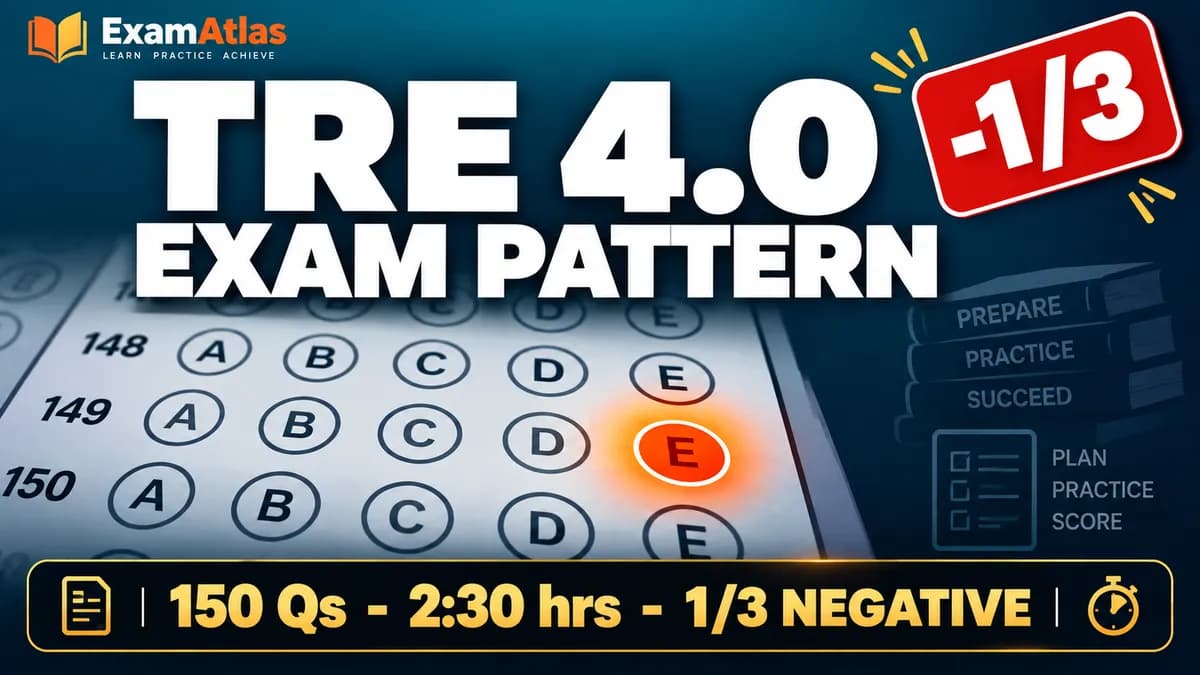
BPSC TRE 4.0 Exam Pattern 2026: Marking Scheme, Option E and Merit Rules
BPSC TRE 4.0 Exam Pattern 2026: 150 Marks, Five Options and 1/3 Negative Marking
Here is the pattern in one line. One objective written exam, 150 questions, 150 marks, 2 hours 30 minutes, five options per question, and 1/3 mark cut for every wrong answer as well as every question you leave blank without marking E.
That last clause is new. TRE 3.0 had no negative marking, so the habit most Bihar teacher aspirants built over 2023 and 2024 was to attempt everything and guess freely. Carry that habit into Advt 15/2026 and your score will be lower than a friend who attempted 20 questions fewer.
Paper structure, level by level
Every question carries one mark. The paper is fully multiple choice, and the same 2:30 clock applies whether you are writing the primary level paper or the higher secondary one.
Part-I is qualifying only, and that changes your prep budget
Part-I tests working knowledge of English plus one language out of Hindi, Urdu and Bangla. You need at least 30% marks in this part, which works out to 9 of 30. Below that, you are out regardless of the rest of your paper.
But these 30 marks do not enter the merit list. They only decide whether you stay in the race. So Part-I deserves enough revision to comfortably clear 30%, not four weeks of grammar drilling.
One practical note: once you select a language subject, the same selection holds for every level you have applied for. You cannot choose Hindi for the Class 6-8 paper and Urdu for Class 11-12.
Where merit actually comes from
Notice that the fighting ground is 120 marks at every level, just assembled differently. For Class 1-5 candidates it is one big General Studies block. For everyone else it is 40 marks of General Studies plus 80 marks of your chosen subject, which means your subject paper carries two-thirds of your fate.
The five-option rule, written out plainly
- Each question shows A, B, C, D and E.
- The correct answer is always one of A, B, C or D.
- Not answering a question? Darkening E is compulsory.
- Darken nothing at all and the question is treated as unattempted, which also attracts the 1/3 deduction.
- Exactly one option per question.
Read that fourth point again. In most exams a blank is neutral. Here a blank is punished exactly like a wrong answer. The only way to "skip" a question without losing marks is to mark E.
What 1/3 negative marking does to your score
Take a Class 11-12 candidate who answers 120 questions and marks E on the remaining 30 in the 120-mark merit portion. Suppose 84 are correct and 36 are wrong.
The fourth row is the trap. Same attempts, same accuracy as row two, but the candidate forgot the E column and lost 6.67 marks for nothing. In a recruitment where thousands sit at the same score band, that gap is several hundred ranks.
The takeaway from rows one to three is simpler: accuracy now beats volume. Practise cutting your attempt count until your accuracy crosses roughly 75%, then push the count back up.
Minimum qualifying marks
These come from resolution nos. 2374 dated 16.07.2007 and 962 dated 22.01.2021. Two cautions. First, the 32% slab for women applies only to women who are permanent residents of Bihar, under General Administration Department letter no. 15937 dated 01.09.2026. Second, a lot of pages still print EBC at 36.5%, which is wrong for TRE 4.0. EBC is 34%.
Clearing the qualifying mark is not the same as getting selected. The Commission also holds discretionary power to fix qualifying marks under Rule 7(v) of the Bihar State School Teacher Rules 2023.
Tie-breaking: what happens when two candidates score the same
This is a quiet argument for taking your subject paper seriously even after you have "enough" marks. At the higher levels, subject score is both two-thirds of your merit and the first tie-breaker.
Guest teacher weightage sits on top
Guest teachers appointed under Education Department resolution no. 51 dated 25.01.2018, who hold the qualification prescribed for higher secondary teacher posts under the Bihar State School Teacher Rules 2023, get 5 marks per year of service, up to a maximum of 25 marks. The same decision taken in Advt 22/2024 has been taken again for TRE 4.0, subject to the outcome of LPA No. 593/2024.
Two conditions matter. An experience certificate and appointment letter issued by the District Education Officer must be submitted, and the weightage is added only after the candidate has secured the minimum qualifying marks in the written exam.
Syllabus standard
All subject papers follow SCERT/NCERT content, but pitched at the level of the minimum qualification prescribed for that post. The General Studies paper is tied to SCERT. Class 9-10 General Studies draws from the secondary school curriculum and Class 11-12 from the higher secondary curriculum. Full topic lists are in our TRE 4.0 syllabus blog.
Class 1-5 aspirants, your paper is a different animal
You have no subject paper. Your entire merit comes from 120 General Studies questions covering elementary mathematics, mental ability, general awareness, general science, social science, the Indian national movement, geography and environment.
That breadth is the challenge. A Class 11-12 Physics candidate can go deep into one subject for 80 marks. You have to hold eight areas at a usable depth for 120 marks, with no single area you can afford to abandon. Build a weekly rotation instead of studying one subject for a fortnight at a stretch.
Two claims on the internet you should ignore
The first is that TRE 4.0 has a preliminary exam followed by a mains. Advt 15/2026 provides for one written objective exam. The Commission may run it across multiple shifts depending on how many people apply, but a shift is a scheduling decision, not an elimination round.
The second is a page that says "no negative marking" in one paragraph and "1/3 negative marking in both Preliminary and Main" in the next. Both halves are wrong. One paper, 1/3 negative. Cross-check anything you read against the Commission's own PDF, and see the notification summary for the source references.
FAQs
How many questions and marks are there in BPSC TRE 4.0?
150 objective questions for 150 marks, to be attempted in 2 hours 30 minutes. This is the same at all four levels.
Is there negative marking in TRE 4.0?
Yes. 1/3 mark is deducted for every wrong answer, and also for every question left unattempted without marking option E.
Do Part-I language marks count in the merit list?
No. Part-I is qualifying only and you need a minimum of 30% in it. Merit comes from Part-II for Class 1-5, and from Part-II plus Part-III for the other levels.
What is the minimum qualifying mark for EBC candidates?
34%. Do not go by pages that list EBC at 36.5%, which is the BC figure.
What happens if two candidates get equal marks?
For Class 1-5 the language part decides, then age, then alphabetical order of the name in Devanagari. For the other levels the subject paper decides first, then language, then age, then alphabetical order.
Will there be an interview or a re-evaluation?
No interview, and no provision for re-evaluation of the answer sheet.
How to rebuild your mock routine this month
Set your next ten mocks to 150 questions in 150 minutes rather than the full 2:30, so the real paper feels roomy. Record two numbers after each: attempts and accuracy. If accuracy sits under 70%, your problem is over-attempting, not speed.
And for every single mock, fill the E column for questions you skip. It takes about four seconds a question, which is 80 seconds across 20 skips. Cheap insurance for 6.67 marks. ExamAtlas TRE mocks already apply the 1/3 rule and flag which sections your accuracy falls in once the penalty is on.