
IBPS Clerk Exam Pattern 2026: Revised Mains with 160 Questions in 125 Minutes
IBPS Clerk Exam Pattern 2026: Revised Mains with 160 Questions in 125 Minutes
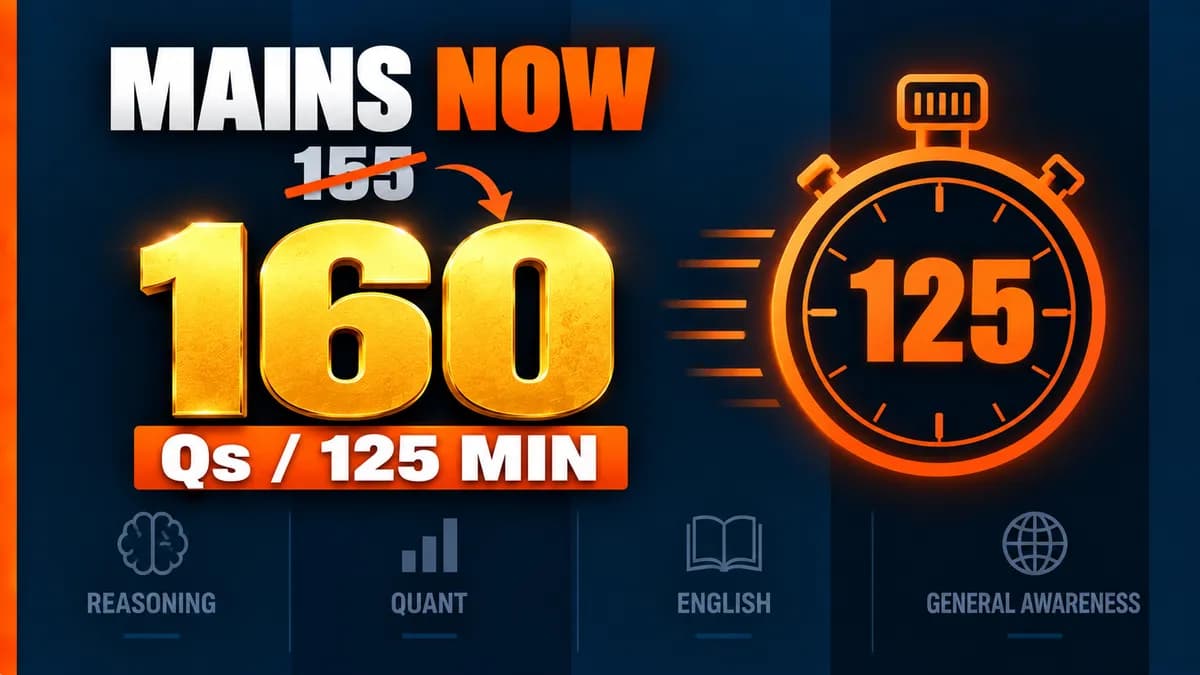
The IBPS Clerk Mains pattern has changed for CRP CSA-XVI. Quantitative Aptitude has moved from 35 questions to 40, the paper total from 155 to 160, and the duration from 120 minutes to 125. Total marks stay at 200.
That is the headline of this cycle, and it matters more than the numbers suggest, because the Mains is the only paper that decides your rank. The Prelims pattern is unchanged. This page covers both stages, the marking scheme, the sectional timing that trips people up, and the Language Proficiency Test that sits at the end.
Selection structure
There is no interview. This is the part candidates misread most often. A brilliant Prelims score gets you nothing except entry to the Mains. Once you are in, everyone starts at zero again.
IBPS Clerk Prelims pattern 2026
- Objective multiple choice, delivered online at the exam centre
- Bilingual, English and Hindi, except the English Language section
- 0.25 marks deducted for every wrong answer
- No deduction for a question left blank
- Held across multiple shifts on 10 and 11 October 2026
What the 20-minute lock actually does to you
Each section opens for exactly 20 minutes and then closes. You cannot carry unused time forward, you cannot go back to a closed section, and you cannot start the next one early.
The practical effect is that your weakest section cannot be rescued by your strongest. A candidate who finishes Reasoning in 14 minutes does not get 26 minutes for Numerical Ability. Those six minutes simply disappear. This is why candidates who practise untimed or single-timer mocks tend to underperform on the day even when their raw ability is fine.
The order is fixed by the system: English first, then Numerical Ability, then Reasoning. Plan a per-section attempt target before you walk in, not while the clock is running.
On sectional cut-offs in Prelims
You will see conflicting claims on this. IBPS publishes Prelims cut-offs state-wise and category-wise as a single figure, and does not release section-level cut-offs. Some coaching sources state that a minimum in each section is still required internally, others say only the overall cut-off applies.
The safe approach does not depend on which is true. With a 20-minute lock per section, a section you cannot score in will pull your total down regardless of whether a separate sectional minimum exists. Prepare so that no section drops below a workable attempt count, and the question becomes academic. For the exact wording, check the CRP CSA-XVI notification PDF on ibps.in.
IBPS Clerk Mains pattern 2026, revised
What changed and what did not
Read the marks column carefully. Quantitative Aptitude went up by five questions but the section is still worth 50 marks, which means the per-question weight came down slightly. The five extra minutes are spread across the paper, not handed to Quant.
So the change is not about more marks for Quant. It is about more questions to get through in a section that was already the tightest on time. Forty questions in 30 minutes is 45 seconds per question. In the previous pattern it was a little over 51 seconds. Calculation speed matters more in this cycle than it did in the last one.
Where the marks actually sit
Reasoning and Computer Aptitude is the heaviest section at 60 marks from 40 questions, so each question there is worth 1.5 marks. General English is the lightest at 40 marks from 40 questions. General and Financial Awareness gives you 50 marks in only 20 minutes, which is the highest marks-per-minute rate in the paper and the reason candidates who neglect banking awareness lose the Mains before they sit it.
- Reasoning and Computer Aptitude: 1.5 marks per question
- Quantitative Aptitude: 1.25 marks per question
- General and Financial Awareness: 1.25 marks per question
- General English: 1 mark per question
0.25 marks are deducted for each wrong answer in the Mains as well. On a 200-mark paper decided by fractions, four wrong guesses cancel one correct answer. Topic-wise coverage for every section is in the IBPS Clerk syllabus guide.
Language Proficiency Test
Conducted after the Mains, for candidates provisionally shortlisted. If you studied the official language of your chosen state or union territory in class 10 or class 12 and can produce the mark sheet, you are usually exempt. If you cannot, you sit the test.
It checks reading, writing and speaking ability in that language. It carries no marks towards merit, but a candidate who fails is disqualified no matter how high the Mains score. This single rule ends more candidatures than most people expect, and it is covered in detail in the IBPS Clerk eligibility guide.
How the final merit list is built
Only Mains marks. They are converted to a 100-point scale, and the state-wise, category-wise merit list is drawn from that. Provisional bank allotment then follows merit and the preferences you submitted with the application.
Because the merit is state-wise, you are competing against candidates who chose the same state as you, not against the whole country. This is why cut-offs vary so widely between states in the same year, and the patterns are worth studying in the IBPS Clerk cut off guide.
What this pattern means for your preparation
Three practical conclusions, and none of them are complicated.
- Practise with sectional timers or do not bother. An untimed mock measures your knowledge. The actual paper measures your knowledge under a 20-minute guillotine. These are different skills and only one of them is tested on 10 October.
- Start General and Financial Awareness now, not after the Prelims result. Fifty marks in 20 minutes is the best rate in the Mains, and it is the only section where preparation directly converts to marks without speed pressure.
- Rebuild your Quant speed drill around 45 seconds per question. The old 51-second rhythm is no longer the target.
ExamAtlas has a free IBPS Clerk Prelims mock test series that runs on the 30-35-35 split with the sectional locks enforced, and reports topic-wise accuracy so you can see which section is costing you the cut-off. The full study plan for both stages is in the IBPS Clerk preparation strategy guide.
Frequently asked questions
What is the IBPS Clerk Mains pattern for 2026?
Four sections totalling 160 questions and 200 marks in 125 minutes: Reasoning and Computer Aptitude 40 questions for 60 marks in 35 minutes, General English 40 for 40 in 35 minutes, Quantitative Aptitude 40 for 50 in 30 minutes, and General and Financial Awareness 40 for 50 in 20 minutes.
What exactly changed in the Mains this cycle?
Quantitative Aptitude went from 35 questions to 40, taking the paper total from 155 to 160, and the duration went from 120 minutes to 125. Marks, section count and section names are unchanged.
Is there negative marking in IBPS Clerk?
Yes, in both Prelims and Mains. Each wrong answer costs 0.25 marks. Questions left unanswered carry no penalty, so blind guessing on a four-option question is not a profitable strategy across a full paper.
Can I move between sections during the Prelims?
No. Each of the three sections runs for exactly 20 minutes and then locks. Time left over in one section is lost, and you cannot return to a section once it closes.
Do Prelims marks count towards the final selection?
No. The Prelims is qualifying only. The entire merit list is built from Mains marks, and there is no interview at clerical level.
Is the IBPS Clerk paper bilingual?
Yes. Questions are available in English and Hindi in both stages, with the exception of the English Language and General English sections, which appear only in English. IBPS also offers the exam in several regional languages.
What is the Language Proficiency Test and when is it held?
It is held after the Mains for shortlisted candidates who cannot show class 10 or 12 study of the local language of their chosen state. It tests reading, writing and speaking, adds nothing to your merit score, and disqualifies you if you fail.
How many questions should I attempt in the Prelims?
There is no fixed number, because cut-offs differ sharply by state. The useful target is accuracy above 85 percent in each section rather than a raw attempt count, since 0.25 negative marking means 70 attempts at 90 percent beats 90 attempts at 70 percent.
The number worth remembering
Forty-five seconds. That is what 40 Quant questions in 30 minutes works out to in the revised Mains, and it is the single number that should reshape how you drill calculation between now and December.
Everything else about this pattern is the same as last year. Start there, and build backwards from the IBPS Clerk complete guide if you need the rest of the cycle detail.