
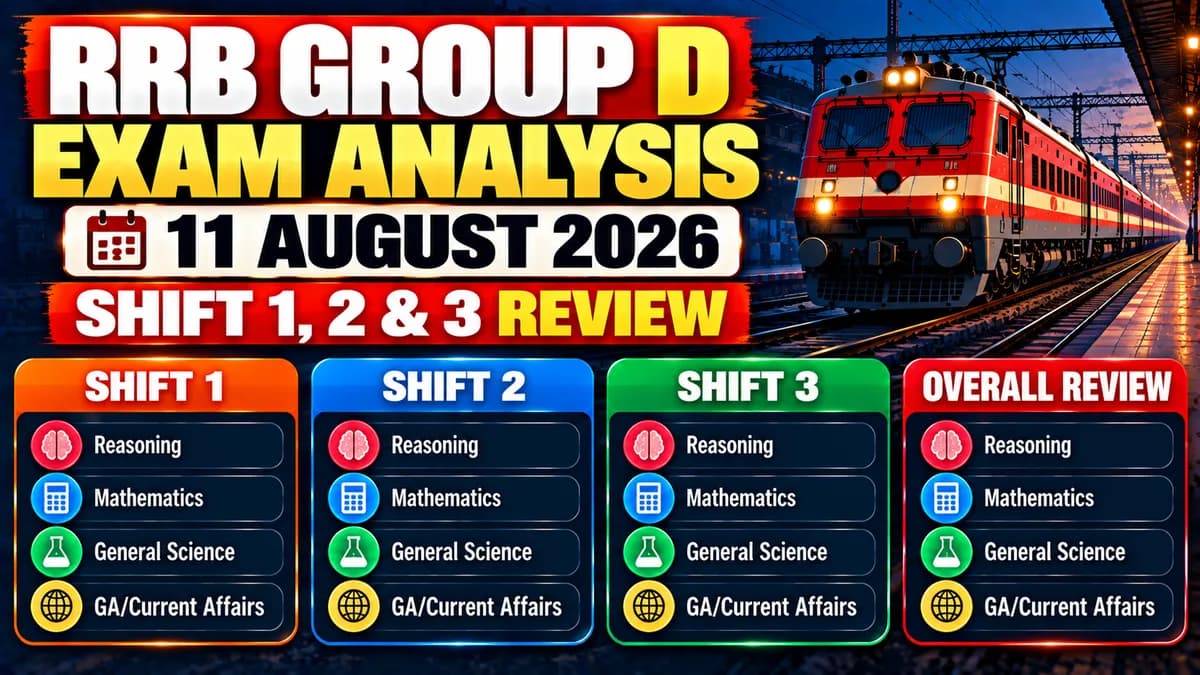
RRB Group D Exam Analysis 11 August 2026: Shift 1, 2 and 3 Review
RRB Group D Exam Analysis 11 August 2026: Shift 1, 2 and 3 Review
11 August was day 7 of the CEN 09/2025 window. By that evening the first week was effectively on record, three more shifts had run, and the paper had done nothing surprising in any of them.
The exam has since closed on 25 August, the answer key arrived on 7 September and the objection window shut on 15 September. This page has been rewritten for where you actually are now, which is waiting on a result with a raw score you can already calculate.
Where this sits now
Shift timings on 11 August 2026
The shift 3 discrepancy was never resolved on any reliable source, and we are leaving it stated rather than picking one. Your call letter carried the timing that counted.
The paper you faced: section wise structure
Ninety minutes, no sectional time limit, one third of a mark deducted per wrong answer, and a qualifying floor of 40 per cent for UR and EWS against 30 per cent for OBC-NCL, SC and ST.
What the first week established
Seven days in, the picture was already stable. Shifts ran easy to moderate, the syllabus stayed exactly where the notification put it, and nothing appeared that candidates had not been told to prepare.
Reasoning was the easiest section on almost every shift. Mathematics carried the spread, meaning the gap between a strong and a weak candidate opened up there more than anywhere else.
That combination matters for a reason that only becomes clear now. When reasoning is easy for everyone, it stops being a differentiator, and the merit order ends up being set by the 25 marks of mathematics and the 20 marks of general awareness.
Section by section: what kept repeating
General Intelligence and Reasoning. Seating arrangement and direction based questions dominated, with series, analogy, coding and decoding and classification filling out the rest. Method driven and fast for anyone who had practised.
Mathematics. Simplification, ratio, percentage, time and work, and profit and loss took most of the twenty five marks. Standard topics throughout, so the separation came from calculation speed under a tight clock.
General Science. Class 10 NCERT level, as prescribed. Physics, chemistry and life sciences in direct, single step questions rather than applied ones.
General Awareness and Current Affairs. Recent affairs weighted well above static general knowledge, drawn from roughly the preceding six to ten months.
Good attempts on 11 August, and what they mean now
These were attempt targets for the day, never a cut off forecast. Six weeks later the distinction matters more, because candidates are now quietly treating old attempt bands as though they predict the boundary.
They do not. The boundary is a zone and category line drawn on normalised scores, using vacancies, candidate numbers and the shortlisting ratio, and our Group D cut off guide sets out how.
Did early shifts get a raw deal?
This is the question candidates who sat in the first week keep asking, and it deserves a straight answer.
The worry runs like this. Early candidates had less information about the paper and no benefit from a week of shift reports, so surely they were at a disadvantage against someone sitting on 24 August.
Two things work against that fear. The syllabus was public from the start, so anyone relying on leaked shift chatter was preparing badly anyway. And normalisation compares you against your own shift, not against the calendar, so sitting early carries no built in penalty.
What early candidates did lose is small and real. A week less revision time. That is worth a couple of marks, not a rank collapse.
One more thing worth saying to the early group. Your response sheet and the final answer key are the same documents everyone else got, released on the same date, so you are not behind on information now either. The only asymmetry that existed closed the moment the key went up on 7 September, and from here every candidate in this recruitment is working with exactly the same set of facts.
Why your raw score is not your final score
Forty eight shifts over sixteen days means forty eight question sets, and no two are identical in difficulty. A 70 from a hard shift outranks a 70 from an easy one once the conversion is applied.
Your scorecard will carry both the raw and the normalised figure, and the merit list uses the second. Why no calculator can produce that number for you is explained in our normalisation explainer.
About memory based question papers
There is no reproduced question on this page, and there should not be one on any page you trust.
Circulating live exam questions carries legal consequences under the Public Examinations Act 2024. A paper stitched together from half remembered questions is also a bad study tool, and a reliable way to talk yourself into a score you did not earn.
What to do now
- Match your saved response sheet against the final answer key and calculate the raw score with negative marking applied.
- Do not compare that figure with someone from another shift. It means very little across shifts.
- Begin PET training if you are anywhere near the qualifying floor. Four to six weeks is the minimum useful run.
- Read the midpoint picture in our 12 August analysis to see how the second week compared.
- Work through what follows the result in our RRB Group D 2026 guide.
ExamAtlas has free Group D practice sets reporting topic wise accuracy, which is the fastest way to find out whether mathematics really was the section that cost you.
Frequently asked questions
How difficult was the 11 August 2026 Group D exam?
Shifts that day ran easy to moderate, matching the first week. Reasoning was the easiest section and mathematics produced the widest spread between candidates.
What counted as a good attempt on 11 August 2026?
Roughly 61 to 71 on a moderate shift and 68 to 76 on an easier one, at about 85 per cent accuracy. With one third negative marking, precision mattered more than the raw number of attempts.
Were early shift candidates at a disadvantage?
Not in any structural way. Normalisation compares you against your own shift rather than against later ones, and the syllabus was public from the start. Early candidates lost some revision time and nothing more.
Can I download the 11 August question paper?
Not from this page. Reproducing live exam questions carries legal consequences under the Public Examinations Act 2024, and memory based compilations are unreliable.
Does a low raw score in a hard shift still have a chance?
Yes, if the whole shift scored low. Normalisation adjusts on the performance of the entire shift, so a score that looks weak in isolation can sit comfortably once converted.
When is the result for this exam expected?
October 2026, with no official date announced by any Railway Recruitment Board. Results and scorecards are published zone by zone on regional RRB websites.
The honest takeaway, six weeks on
When this was written on 11 August, the useful advice was for candidates with shifts still to come. That audience no longer exists, and pretending otherwise would waste your time.
Here is what day 7 is actually worth to you today. It confirmed the exam was stable and predictable, which means your raw score is a fair reflection of your preparation rather than of the paper you happened to draw. Calculate it honestly, and if it sits anywhere near your zone's likely range, spend October carrying weight rather than reading analyses.