
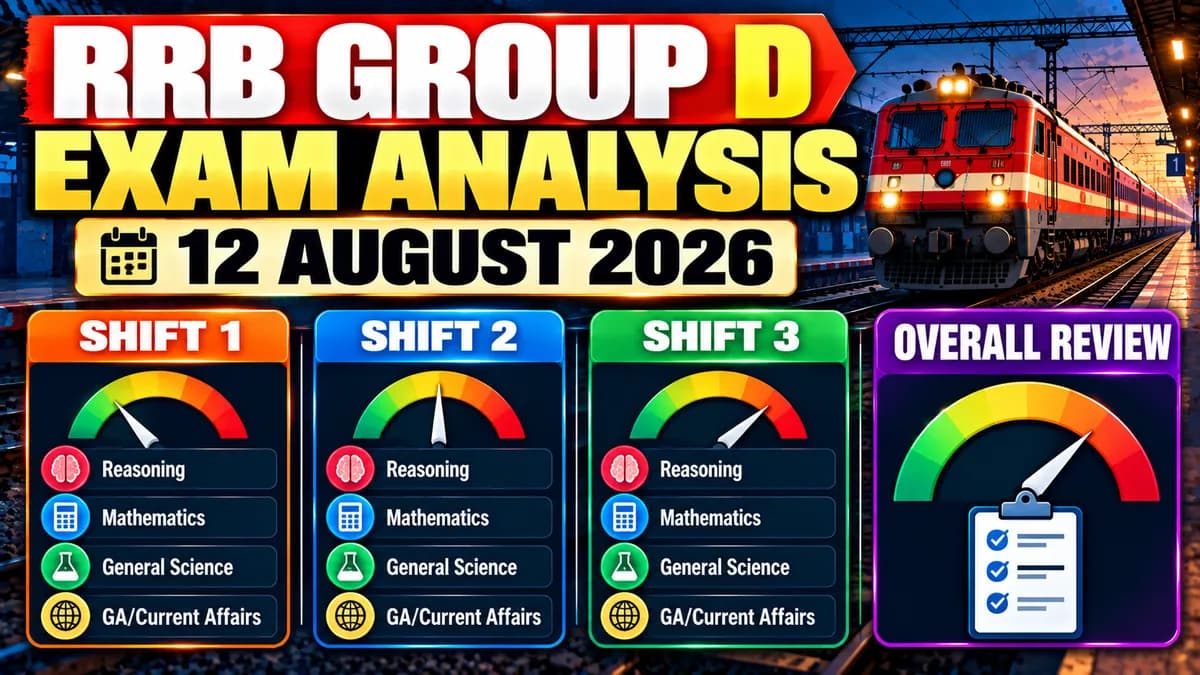
RRB Group D Exam Analysis 12 August 2026: Shift 1, 2 and 3 Review
RRB Group D Exam Analysis 12 August 2026: Shift 1, 2 and 3 Review
12 August was day 8 of a 16 day exam window, the exact midpoint of CEN 09/2025. Three shifts ran that day, the paper held its shape, and nothing outside the notified syllabus turned up.
That day is now history. The full window closed on 25 August, the answer key came on 7 September and objections shut on 15 September. This page has been updated so the analysis is read for what it is worth today, which is a guide to what your normalised score is about to do.
Where this sits now
Shift timings on 12 August 2026
We never resolved the shift 3 discrepancy and we are not going to pretend otherwise. Candidates who sat that slot should go by the timing printed on their own call letter, which is the only version that counted.
The paper: section wise structure
Ninety minutes, no sectional time limit, and one third of a mark deducted per wrong answer.
What the midpoint showed
By 12 August the pattern across eight days was settled. Shifts sat between easy to moderate and moderate, with no day breaking out in either direction.
Reasoning stayed the most scoring section throughout, which matters because it carries the largest block at 30 marks. Mathematics was the section that moved most between shifts, and that variation is precisely what normalisation exists to handle.
General Science held to Class 10 level. General Awareness leaned on the last six to ten months of current affairs rather than static general knowledge.
Section by section: what kept repeating
General Intelligence and Reasoning. The largest block at 30 marks and consistently the most scoring. Seating arrangement and direction based questions came up again and again, alongside series, analogy, coding and decoding, and classification. Candidates who had drilled these to a method finished the section quickly and banked time for mathematics.
Mathematics. Twenty five marks and the section that decided outcomes. Simplification, ratio, percentage, time and work, and profit and loss carried the bulk. No exotic topics appeared, so the differentiator was calculation speed rather than knowledge.
General Science. Class 10 level, as the syllabus prescribes. Physics topics around motion, light, work and energy, chemistry around acids, bases and the periodic table, and life sciences around human body systems and nutrition. Direct questions, very little reasoning required.
General Awareness and Current Affairs. Twenty marks drawn from roughly the last six to ten months, weighted toward sports, awards, schemes and appointments rather than static general knowledge. This was the section candidates most often reported as the one that cost them.
Good attempts on 12 August, and what they mean now
Read those bands carefully now. They were an estimate of a healthy attempt count on the day, not a prediction of the cut off, and they never were.
The number that decides your fate is your normalised score against your zone's boundary, and the four things that fix that boundary are set out in our Group D cut off guide.
Why your raw score is not your final score
48 shifts across 16 days means 48 different question sets. A 70 earned in a hard shift is a stronger performance than a 70 earned in an easy one, and the merit list has to reflect that.
So the RRB converts raw marks onto a common scale before ranking anyone. Your scorecard will show both figures. The mechanics, and why no online calculator can produce your number, are in our normalisation explainer.
This is why candidates who left the hall on 12 August feeling flat sometimes finish above candidates who felt comfortable on a different day.
What this day tells you about your own shift
If you sat on 12 August, your paper was drawn from the same bank and built to the same difficulty target as every other day in the window. That is the point of a standardised CBT.
So the honest reading is that 12 August was an unremarkable day in a consistent exam. Nobody got a gift paper and nobody got wrecked by one.
That consistency is good news and bad news at once. It means normalisation has less work to do, which protects you from a freak adjustment. It also means the boundary will be set by how many people answered accurately, not by paper luck, and roughly 58 lakh applicants against 22,195 posts is a hard enough filter on its own.
About those memory based question papers
You will not find a reproduced question on this page and you should be wary of any page that does offer them.
Reproducing or circulating live exam questions carries legal consequences under the Public Examinations Act 2024. Beyond the legal risk, a PDF assembled from half remembered questions is a poor study tool and a good way to convince yourself of a score you did not get.
What to do now that the key is out
- Open the response sheet you downloaded in September against the final answer key and count your raw score with negative marking applied.
- Stop comparing that raw score with friends from other shifts. It tells you very little.
- Start physical preparation if your score is anywhere near the qualifying floor of 40 per cent for UR and EWS or 30 per cent for OBC-NCL, SC and ST.
- Check the day 7 read alongside this one in our 11 August analysis if you want the first week's picture.
- Read the stages that follow the result in our RRB Group D 2026 guide.
ExamAtlas has free Group D practice sets that report topic wise accuracy, which is how you find out whether reasoning really was your strong section or it only felt that way.
Frequently asked questions
How difficult was the 12 August 2026 Group D shift?
Shifts that day sat between easy to moderate and moderate, in line with the first week. Reasoning was the most scoring section and mathematics varied most between shifts.
What was a good attempt on 12 August 2026?
Between 61 and 71 for a moderate shift and 68 to 80 for an easier one, at roughly 85 to 88 per cent accuracy. With one third negative marking, accuracy mattered more than volume.
Does a good attempt figure tell me the cut off?
No. Good attempts were an estimate of a healthy performance on that day. The cut off is a zone and category boundary drawn on normalised scores after the whole exam, using vacancies, candidate numbers and the shortlisting ratio.
Can I get the 12 August question paper?
Not from us. Reproducing live exam questions carries legal consequences under the Public Examinations Act 2024, and memory based papers are unreliable in any case.
My shift felt harder than the ones described here. Will normalisation help?
Possibly, but not automatically. The adjustment depends on how your whole shift performed, not on how the paper felt to you. If most candidates in your shift scored well, the shift will not be read as a hard one.
When will the result for this exam come out?
October 2026 is the expected window, with no official date announced by any RRB. Results are published zone by zone on regional RRB websites.
The halfway takeaway, read six weeks later
Written on the day, this page told candidates with shifts still ahead that the paper was stable and worth attacking with accuracy rather than volume. That advice has expired.
What survives is the single useful fact from 12 August. The paper was consistent, which means very few candidates gained or lost a large amount purely on shift luck, which in turn means the boundary this year will be decided by ordinary competition rather than by a freak paper. Prepare for the PET on that assumption.