
SSC CGL 2026 Post Preference and Salary: How to Choose Without Guessing
SSC CGL 2026 Post Preference and Salary: How to Choose Without Guessing
Status as on 13 September 2026: the SSC CGL 2026 application is closed, the final last date having been 25 June 2026 after SSC reopened the window from 23 to 25 June. Tier 1 runs from 30 September 2026 to 30 October 2026 as a Computer Based Examination across multiple days, and the admit card has not been released yet.
So you have about two and a half weeks before the first shift. This is exactly the window in which most aspirants start asking a second question alongside "how do I clear Tier 1": which post should I actually put first, and what will it pay me?
This page answers both, with one rule running through it. Where the pay level is confirmed, you get the number. Where it is not, you get a plain sentence saying so instead of a made-up figure. That distinction matters more on this topic than on any other SSC CGL page, and the reason will be obvious by the third section.
What SSC CGL 2026 actually pays: the confirmed range
The SSC CGL 2026 notification covers roughly 40 Group B and Group C posts against a tentative 12,256 vacancies. Those posts do not all sit on one salary. They are spread across a band of the 7th CPC pay matrix.
Here is what is confirmed for this cycle.
Read the Pay Level-4 figure correctly, because a lot of aspirants misread it. Rs 25,500 is the entry cell of Level-4. Rs 81,100 is the top cell of that same level, which you reach only after many years of annual increments inside the level. It is not a starting range. Nobody joins on Rs 81,100.
The same logic applies upward. A Level-7 post starts higher than a Level-4 post and a Level-8 post starts higher than Level-7, and each level has its own ladder of increment cells. That ladder is why two officers with the same designation can draw visibly different basic pay: one has ten years in the level, the other has ten months.
Why ASO at Level-7 and AAO at Level-8 is the fact most pages get wrong
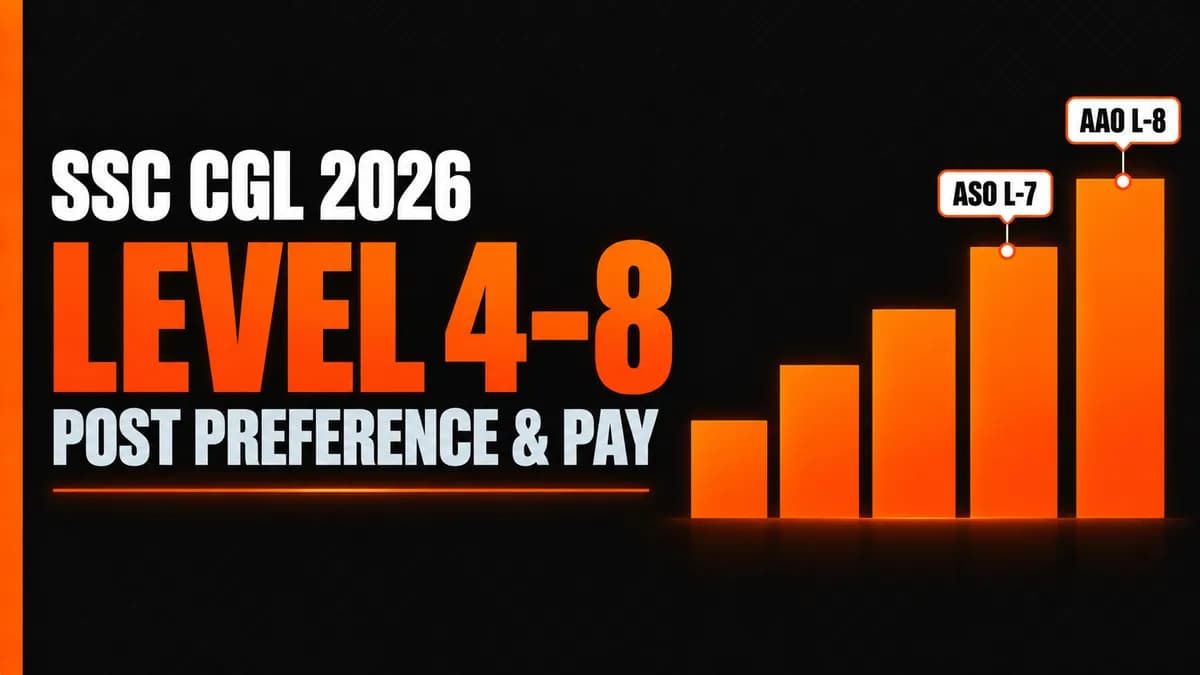
Search "SSC CGL salary post wise" and you will find page after page listing Assistant Section Officer in CSS at Pay Level-8. It is not Level-8. ASO (CSS) is Pay Level-7 with grade pay 4600. The post that sits at Pay Level-8 with grade pay 4800 is Assistant Audit Officer and Assistant Accounts Officer, the post filled through Paper 3 of Tier 2.
This is not a small slip. It is the single most consequential error on SSC CGL salary pages, and it spreads because everybody copies everybody. An aspirant who believes ASO and AAO sit on the same level will fill the preference form thinking the two posts pay the same, and will rank on work profile alone. They do not pay the same. AAO is a full level above.
The reason so many writers confuse them is the naming. ASO, AAO, AAO again for Assistant Audit Officer, all three initialisms look alike on a form at 11 pm. Slow down there. Check the expansion, not the acronym. Our full breakdown of the pay structure lives on the SSC CGL salary page, and it carries the same two levels.
The post-wise pay level table we are not going to invent
You want a table with all forty-odd posts in the left column and a pay level in the right column. We know. Every competitor page has one.
Most of those tables are guesses, and you already know one of the guesses is wrong, because that is how ASO ended up at Level-8 across half the internet. Once one entry in a table is fabricated, the whole table stops being usable, and you have no way of telling which row is the fabricated one.
So here is our position. The complete post-wise pay level table for SSC CGL 2026 is in the annexure of the official notification PDF on ssc.gov.in. That annexure is the only version of this table anyone should be filling a preference form from. ExamAtlas will publish the post-wise levels once we have confirmed each figure against that PDF, and not before.
Until then, the two entries above are the ones you can act on, and the Level-4 to Level-8 band tells you the outer edges. If a page hands you a forty-row table with no source named, treat the whole thing as unverified. That is a fair test to apply to us as well.
How post preference actually works in SSC CGL
Preference is not part of the application form you filled in June. Several aspirants think they have already locked their choices. They have not.
SSC opens a separate post preference window after the Tier 2 examination, and it is at that stage that you rank the posts and the departments you are willing to join. Three things about that stage decide a lot of futures.
1. The order is binding
You are not writing a wish list. The order you submit is the order the allocation software reads. If you rank a post first and your normalised Tier 2 marks reach that post's cut off for your category, you get that post. You do not get asked again, and you do not get to compare offers.
This is why "I will put the famous post first and decide later" is a bad plan. There is no later.
2. Rank every post you would accept
Leaving posts blank does not protect you from them. It removes you from consideration for them. An aspirant who ranks only four posts and misses all four cut offs can end up with nothing while a candidate with lower marks who ranked twenty posts gets an allocation. Rank widely, in honest order of preference, all the way down to the last post you would genuinely join.
3. Three separate merit lists change the maths
SSC does not run one merit list. It runs three, and this is the part that changes preference strategy most.
JSO and Statistical Investigator Grade-II sit on their own lists with their own cut offs. So an aspirant who is eligible for the statistics posts is effectively competing in two races at once, and a mark that falls short on List-3 can still land a post on List-1 or List-2, or the reverse. AAO is filled through Paper 3, Finance and Economics, on the general list. Details of all three papers are on the SSC CGL Tier 2 page.
What should decide your preference order besides pay level
Pay level is one input. Aspirants who have been in service five years will tell you it is rarely the input they would rank first, given a second chance.
Posting location and transfer liability
Some posts are all-India transferable, some keep you in one zone, and a few keep you in Delhi for most of your career. If you have a dependent parent in Muzaffarpur or a spouse posted in Ranchi, transfer liability is not a footnote, it is the decision. Ask serving officers in that department what the actual transfer cycle looks like, not what the rulebook says.
The department, not just the designation
The same designation in two ministries can mean two different working lives. Work culture, file load, public dealing, court work and the seniority position you inherit all vary by department. The post name on the preference form hides all of it.
Promotion path and how fast it moves
A post one level lower with a faster promotion channel can overtake a higher starting post inside a decade. Look at where each post's next two promotions sit and how long officers typically wait for them. Departments with a wide base and a narrow top move slowly.
Work profile and whether you will tolerate it
Desk-heavy file work, field investigation, audit, assessment and enforcement are genuinely different jobs. Plenty of people chase a post for its reputation and spend the next twenty years doing work they dislike. Be honest about which of those you can sustain.
Skill test and typing requirements
Some posts require the Data Entry Speed Test or a computer proficiency component. It is part of the Tier 2 structure and it is qualifying, but if your typing is weak it is a real risk and should influence how you rank the posts that depend on it.
Physical standards, where they apply
A handful of posts add a physical standards test on top of everything else. More on that next.
Which SSC CGL posts carry physical standards
Physical standards apply to the investigative and enforcement posts. CBI, NIA, the Narcotics Control Bureau and similar posts require candidates to meet prescribed physical measurements and medical conditions in addition to the written stages.
The exact height, chest and vision figures, and the way they differ by gender and by category, are set out in the official notification PDF. We are not going to print measurements here, because a wrong number on a physical standard is the kind of error that makes someone rank a post they cannot clear. Read the annexure on ssc.gov.in and confirm your own figures against it before you rank any of these posts.
One practical point. Do not rank an enforcement post highly on the strength of the uniform and the reputation if you have not checked whether you meet the standard. Failing the physical stage after clearing Tier 2 is a painful way to lose a year.
Post-specific eligibility: JSO, Statistical Investigator Gr-II and AAO
Most SSC CGL posts need a bachelor's degree from a recognised university and nothing more. Three posts add their own requirement, and missing it is the reason some candidates cannot rank the post they wanted.
Note how tight the Statistical Investigator condition is. Statistics in one or two semesters does not satisfy it. It has to run through every year or semester of the degree, and that single line disqualifies a large number of graduates who assume a statistics paper somewhere in the course is enough.
For AAO, the CA and CMA qualifications are listed as desirable rather than mandatory, so a plain graduate can and should rank AAO if the Finance and Economics paper suits them. The base age band is 18 to 32 years and it varies post to post; the exact post-wise age band sits in the official notification annexure, which is also where you should check your own eligibility rather than relying on a summary. Our SSC CGL eligibility page tracks the confirmed conditions. Remember also that the crucial date for eligibility moved with the reopened window and is now 25 June 2026.
Let cut off data build your preference order
The most useful thing you can do before ranking posts is look at where the marks actually landed. The 2024 Tier 2 post-wise cut offs show the gap clearly.
Look at the UR row first. ASO in CSS closed at 533.2468 against 438.6747 for the statistical posts, a gap of nearly 95 marks. That is not a rounding difference, it is a different league of score, and it tells a UR candidate something concrete: ASO CSS is among the hardest posts to reach on marks alone.
Now look at the other rows, because they flip. For EWS, OBC, SC and ST, the statistical posts closed higher than ASO CSS in 2024. An OBC candidate needed 348.5815 for ASO CSS but 411.6871 for JSO or SI Gr-II. The reason is the separate lists, the far smaller number of statistics-eligible candidates, and the small vacancy count on those lists.
The takeaway is not a formula. It is that a preference order copied from a topper's video is close to useless, because the right order depends on your category and on which lists you are eligible for. Pull last year's numbers for your own category before you rank anything. You can check them on the verified SSC CGL cut off tool, and one caution: the 2025 final result was revised after FRTA on 14 May 2026, with 15,118 candidates provisionally selected across 57 posts and 115 cut offs across 39 posts moving down. The full post-wise 2025 table is not out, so 2024 remains the most complete post-wise reference we have.
One more reason the decimals run to five places: SSC normalises marks when an exam runs across multiple shifts, which this one certainly does across 30 September to 30 October. How that works is explained on the SSC CGL normalisation page.
A workable way to build the list
Start by removing every post you are not eligible for. The statistics conditions and the physical standards will do most of that pruning for you.
Then sort what remains by location and transfer liability, because that filter is the one you cannot change after joining. Inside each location group, order by pay level where it is confirmed and by promotion path where it is not. Finally, check your ordering against last year's cut off for your category, and if your realistic mark range sits below a post's closing mark, keep the post on the list anyway but lower down. Ranking it costs nothing.
Do that work now, on paper, while Tier 1 is still ahead of you. The preference window opens after Tier 2, and by then you will not have the bandwidth.
And the honest caveat: none of this matters if Tier 1 does not go well, and Tier 1 in 2026 has sectional timing, with each of the four sections carrying its own 15-minute timer. If you are still practising with a single 60-minute clock, fix that this week. ExamAtlas runs SSC CGL Tier 1 mock tests in the current sectional format, and the SSC CGL hub tracks every stage of this cycle as it moves.
FAQs
What is the salary range in SSC CGL 2026?
SSC CGL 2026 posts fall between Pay Level-4 and Pay Level-8 of the 7th CPC matrix. Pay Level-4 runs from Rs 25,500 to Rs 81,100, where Rs 25,500 is the entry cell and Rs 81,100 is reached only after years of increments within that level. The post-wise level for each individual post is listed in the official notification PDF annexure on ssc.gov.in.
Is ASO in CSS Pay Level-7 or Pay Level-8?
ASO, Assistant Section Officer in CSS, is Pay Level-7 with grade pay 4600. It is not Level-8. The SSC CGL post at Pay Level-8 with grade pay 4800 is Assistant Accounts Officer and Assistant Audit Officer. Many prep sites print ASO as Level-8, and that is one of the most widely copied errors on SSC CGL salary pages.
Where do I find the pay level of every SSC CGL post?
In the annexure of the official SSC CGL 2026 notification PDF on ssc.gov.in. ExamAtlas has deliberately not published a full post-wise pay level table because the figures for posts other than ASO and AAO are not confirmed here, and we will publish it once each row is checked against the official PDF.
When do I fill the SSC CGL post preference form?
The post preference window opens after the Tier 2 examination, not during the application. The order you submit is binding on the allocation, so rank every post you would accept, in honest order, rather than listing only three or four.
Why does SSC publish three separate cut off lists?
Because JSO and Statistical Investigator Grade-II have their own eligibility and their own Tier 2 paper. List-1 is JSO, List-2 is Statistical Investigator Grade-II, and List-3 covers all other posts. A candidate eligible for the statistics posts appears on more than one list and so has more than one route to an allocation.
Which SSC CGL posts have physical standards?
Posts in CBI, NIA, the Narcotics Control Bureau and similar investigative or enforcement organisations require candidates to meet prescribed physical standards and medical conditions. The exact height, chest and vision requirements are in the official notification PDF annexure and should be checked there before you rank these posts.
What was the last date to apply for SSC CGL 2026?
The final last date was 25 June 2026. SSC reopened the application window from 23 to 25 June 2026 after the original closing date of 22 June, and the reopened date also became the crucial date for deciding eligibility. Fee payment closed on 26 June 2026 and the correction window ran from 1 to 3 July 2026.