
IBPS Clerk Salary 2026: In-Hand Pay, Allowances, Job Profile and Promotion
IBPS Clerk Salary 2026: In-Hand Pay, Allowances, Job Profile and Promotion
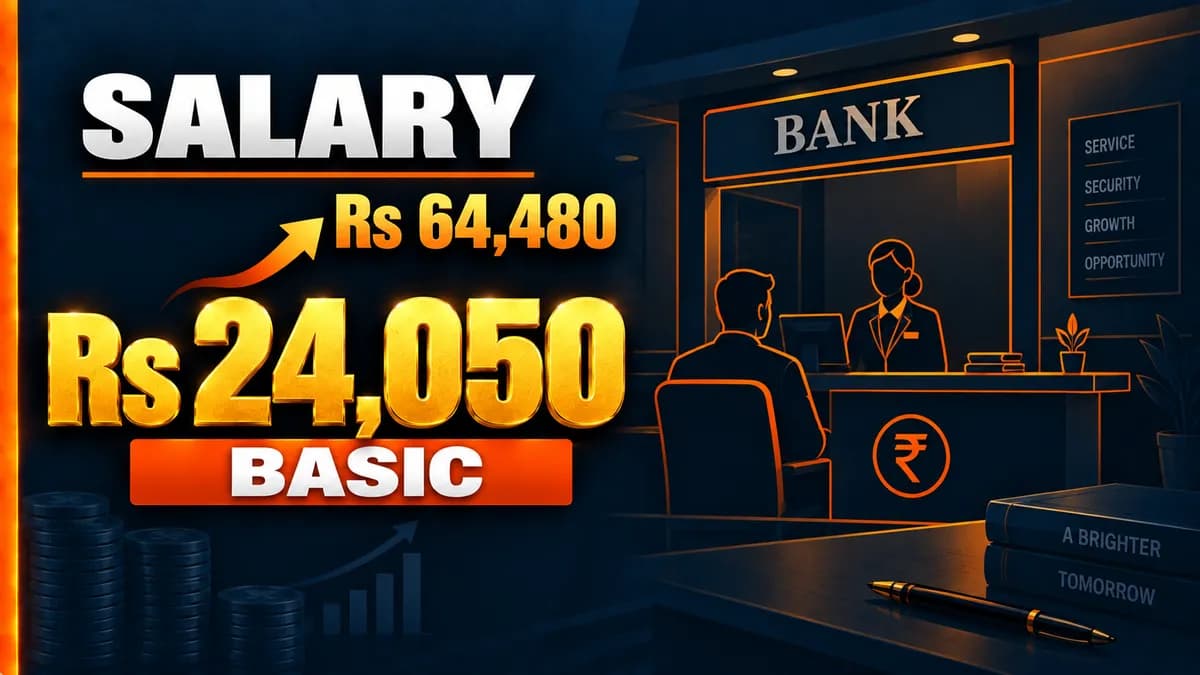
The basic pay for an IBPS Clerk, officially a Customer Service Associate, starts at Rs 24,050. That number on its own tells you very little, because basic pay is roughly half of what actually reaches your account.
Once Dearness Allowance, House Rent Allowance, Special Allowance and Transport Allowance are added, gross in a metro posting works out to around Rs 40,000 to Rs 42,000 a month, before deductions. In a small town the same job pays noticeably less, and the reason is HRA, not any difference in the work.
Pay structure at a glance
What makes up the salary
- Basic pay. Rs 24,050 at entry. Every other component that is calculated as a percentage sits on top of this, so basic pay drives the whole structure.
- Dearness Allowance. Linked to the Consumer Price Index and revised quarterly. This is the component that moves without you doing anything, and over a few years it becomes a large part of the total.
- House Rent Allowance. Paid as a percentage of basic pay and tied to the classification of your posting city. A metro posting pays materially more than a rural branch for identical work.
- Special Allowance. A fixed percentage of basic pay, and it also attracts DA.
- Transport Allowance. A modest fixed component.
Deductions reduce the gross figure. Provident Fund or NPS contribution, professional tax where the state levies it, and income tax once your total crosses the threshold. Net in hand for a first-year clerk in a metro is usually in the mid-thirties once these come off.
DA revisions mean any in-hand figure you read anywhere, including this page, is a snapshot. Treat the range as indicative and check your own salary slip in month one.
How to read your first salary slip
New clerks often expect one number and see nine lines instead. This is what the slip is built from, and knowing the basis of each line tells you which ones will grow and which will not.
Notice that four of the five earning lines are calculated on basic pay. That is why an annual increment matters more than it looks on paper, because it lifts DA, HRA and Special Allowance along with it.
The other consequence is that the gap between a metro and a small-town posting widens as your basic pay rises, since HRA is a percentage rather than a fixed amount. A clerk in Mumbai and a clerk in Muzaffarpur start with a modest difference and end up further apart in year ten doing identical work.
Benefits beyond the monthly credit
These are easy to ignore when comparing offers and they are worth real money.
- Medical aid and reimbursement for the employee and dependents
- Leave Fare Concession, usable periodically for travel
- Provident Fund or NPS, plus gratuity and pension benefits as applicable
- Staff housing loans, vehicle loans and personal loans at concessional rates, which over a home loan tenure is often the single largest financial benefit of a bank job
- Leave entitlements including casual, privilege and sick leave
- Reimbursement of newspaper and mobile expenses in many banks
The job you are actually applying for
A Customer Service Associate sits at the branch counter and is the first person a customer deals with. The work is transactional, steady and public-facing.
- Cash receipt and payment, and cash balancing at day end
- Account opening, KYC documentation and updates
- Passbook printing, cheque book issue, demand drafts
- Clearing, NEFT and RTGS entries
- Deposit and withdrawal processing, fixed and recurring deposit servicing
- Basic customer queries, complaint logging and account maintenance
- Cross-selling of insurance and third-party products in many branches
Two honest points about the role. Branch hours are fixed but cash balancing can keep you past closing, particularly at month and quarter end. And in most public sector banks a clerk is posted within the state they applied for, which is a real advantage over recruitments that can send you across the country. The comparison on postings and transfers is in the IBPS Clerk vs SBI Clerk guide.
Career growth from clerk to officer
The clerical cadre is not a terminal post. There are two routes upward and most people use both.
Internal promotion
After the eligibility period each bank sets, a clerk can appear for the internal promotion process to Officer Scale I, usually a written test and interview conducted by the bank. This is the route most clerks take, and clearing JAIIB and CAIIB from the Indian Institute of Banking and Finance both helps in the process and adds increments.
Fast-track and direct routes
Some banks run a fast-track channel for clerks who clear JAIIB and CAIIB early with strong performance ratings. Separately, nothing stops a serving clerk from sitting IBPS PO or SBI PO as an outside candidate while employed, and a fair number do exactly that in their first two or three years.
A typical progression, and the timelines vary by bank and by vacancy: Clerk, then Officer Scale I, then Scale II as Manager, then Scale III as Senior Manager. Reaching Scale II or III makes the pay a different conversation altogether.
Is the pay worth the preparation?
An opinion, since the numbers alone do not settle it. For a graduate in a tier-2 or tier-3 town, an entry package in the high thirties with medical cover, concessional loans and a pension structure is a strong outcome, and the posting stays within the home state.
For someone already earning above that in a private role in a metro, the case rests on stability, the loan benefits and the promotion ladder rather than on the starting figure. Going in expecting the starting salary alone to justify the switch usually leads to disappointment in year one.
What is not in dispute is the entry cost. No interview, no fee beyond Rs 850, and selection decided entirely by a written Mains paper. Very few recruitments at this pay level are that transparent about how the merit list is built, which is explained in the IBPS Clerk exam pattern guide.
Frequently asked questions
What is the IBPS Clerk in-hand salary in 2026?
Gross in a metro posting works out to roughly Rs 40,000 to Rs 42,000 per month, with net in hand usually in the mid-thirties after PF, professional tax and income tax. Smaller cities pay less because House Rent Allowance depends on the city classification.
What is the basic pay for an IBPS Clerk?
Rs 24,050 at entry. The clerical pay scale rises to Rs 64,480 over roughly twenty years of service through regular increments.
Why does the salary differ between cities?
Mainly House Rent Allowance, which is calculated as a percentage of basic pay and varies with how the posting city is classified. The basic pay, DA and Special Allowance are the same wherever you are posted.
Is there a probation period?
Yes, normally six months, and banks may extend it in individual cases. Salary is paid in full during probation.
What does a Customer Service Associate do every day?
Counter work at a branch: cash receipt and payment, account opening and KYC, passbook and cheque book issue, clearing and fund transfer entries, deposit servicing and customer queries. Many branches also expect cross-selling of insurance and third-party products.
How does a clerk become an officer?
Through the bank's internal promotion process to Officer Scale I after the eligibility period, usually a written test and interview. Clearing JAIIB and CAIIB helps in that process and adds increments. A serving clerk can also sit IBPS PO or SBI PO as an outside candidate.
Do IBPS Clerks get a pension?
Employees are covered under the applicable retirement benefit structure, which for recent entrants is the National Pension System along with gratuity. The exact terms follow the bank and the prevailing service rules.
Will I be posted outside my home state?
Generally no. IBPS Clerk vacancies are advertised state-wise and you selected a single state in the application, so posting is normally within that state. This is one of the main reasons candidates prefer it over recruitments with all-India transfer liability.
The figure most comparisons leave out
Concessional staff loans. A housing loan at a staff rate over a twenty-year tenure saves an amount that dwarfs the difference in starting salary between this job and most alternatives at the same entry level.
It never appears in a salary table because it is not paid monthly, which is exactly why candidates comparing offers on gross pay alone tend to undervalue a bank job. Eligibility and the rest of the recruitment detail are in the IBPS Clerk eligibility and IBPS Clerk complete guide pages.