
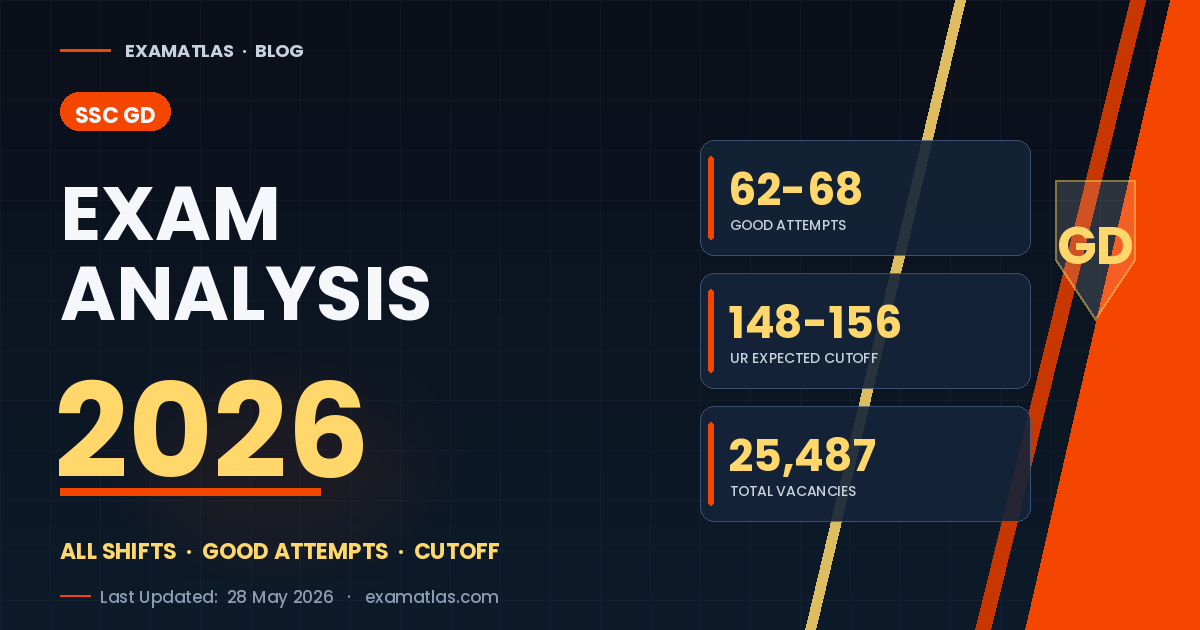
SSC GD Exam Analysis 2026: All Shifts, Good Attempts & Expected Cutoff
SSC GD Exam Analysis 2026: All Shifts, Good Attempts & Expected Cutoff
Last Updated: 28 May 2026 — covering all four phases of the SSC GD Constable 2026 CBT, conducted from 27 April to 30 May 2026.
The SSC GD Constable 2026 CBT wrapped its final phase this week, with 25,487 vacancies on the table — less than half of last year's 53,690. Over 25 lakh candidates wrote the paper across the four phases, which means the merit fight is sharper than the difficulty level suggests.
This is the honest, shift-by-shift verdict. You will find the overall difficulty, realistic good attempts, section-wise trends, expected cut-off across categories, how normalisation plays out, and a quick strategy note if your shift was tougher than the rest. No inflated numbers, no guesswork dressed as data.
SSC GD 2026 Quick Verdict (Section-Wise Good Attempts)
Here is the one table most aspirants are searching for. Use this as your reference point when you compare your own attempt sheet.
The pattern across all four phases stayed remarkably consistent. Reasoning was the most scoring section, GK was the swing section that decided who cleared, and Maths and English landed in between — comfortable for anyone who revised basics.
Phase-Wise Difficulty Verdict
One date shifted from 28 May to 27 May because of the Bakrid holiday adjustment announced by the government. If a shift felt harder than expected, in nine cases out of ten the difficulty was concentrated in two or three GK questions, not in Maths or Reasoning.
SSC GD 2026 Exam Overview
SSC GD 2026 Exam Pattern
Marking Scheme: The Rules That Decide Your Score
- Each correct answer gives you 2 marks.
- Each wrong answer costs you 0.5 marks (0.25 of a 2-mark question).
- There is no sectional timing. The full 60 minutes is yours to split.
- The exam is bilingual — you pick English or Hindi for the language paper.
- No sectional cut-off in the CBT, so your total score is what matters for the merit list.
This single rule — no sectional timing — is exactly why time management decides scores in SSC GD, not knowledge alone. Strong candidates do not just know more, they finish Reasoning and English in under 25 minutes and leave the saved time for GK.
Section-Wise Analysis & Good Attempts Breakdown
1. General Intelligence & Reasoning
- High-weight topics: analogy, odd one out, series, coding-decoding, mirror and water images, non-verbal reasoning.
- Difficulty: easy across all four phases. This is your scoring engine.
- Good attempts: 17 to 19 out of 20.
- Tip: Finish Reasoning fast and clean so the saved minutes flow into GK later.
2. General Knowledge & General Awareness
- High-weight topics: static GK, current affairs of the last six months, basic science, government schemes, awards, sports, important days.
- Difficulty: moderate, and the most unpredictable section from one shift to the next.
- Good attempts: 12 to 15 out of 20.
- Tip: This is the marks-deciding section. Two extra correct answers here can lift you above the cut-off.
3. Elementary Mathematics
- High-weight topics: simple and compound interest, percentage, ratio and proportion, average, time and work, profit and loss, number system.
- Difficulty: easy to moderate. Almost fully arithmetic; no geometry or algebra surprises.
- Good attempts: 16 to 18 out of 20.
- Tip: Speed comes from formula recall. Revise SI, CI and percentage formulas daily till exam day.
4. English / Hindi
- High-weight topics: fill in the blanks, error spotting, synonyms and antonyms, one-word substitution, short comprehension.
- Difficulty: easy for both language options.
- Good attempts: 16 to 18 out of 20.
- Tip: Do not overthink. The questions reward basics, not advanced grammar.
Good Attempts: The Full Picture
- A strong candidate is landing 62 to 68 good attempts with high accuracy.
- Reasoning + Maths together should give you 33 to 37 of those attempts.
- English or Hindi adds another 16 to 18.
- GK fills the rest, and is where most shift-to-shift variation happens.
- Above 68 attempts with low errors puts you comfortably above the expected cut-off.
Remember the negative marking. Blind guessing on 10 unsure questions can quietly cost you 5 marks, which is more than two full questions. Discipline beats heroics here.
SSC GD 2026 Expected Cutoff (Category-Wise)
The 2026 cycle offers 25,487 posts against last year's 53,690. Fewer seats with the same demand pool usually pushes the cut-off up by 5 to 10 marks. Treat the figures below as informed estimates built on previous-year trends, not a promise from SSC.
Factors That Decide the Final Cutoff
- Vacancy count. Fewer posts in 2026 means the bar rises across categories.
- Total candidates appearing. SSC GD always draws a huge pool — 25+ lakh this cycle.
- Overall difficulty across phases. Easier the paper, higher the cut-off.
- Normalisation. Since the exam runs in many shifts, marks are adjusted.
- State-wise and category-wise reservation. State quota affects the merit cut for state-domicile candidates.
The official cut-off comes only with the result, expected around July 2026 on ssc.gov.in. Anything before that — including this estimate — is a trend-based prediction, not a guarantee.
Normalisation: Why Your Raw Score Is Not Final
- Because SSC GD ran across many shifts over a month, SSC applies normalisation to keep things fair.
- If your shift was tougher than the average, normalisation can lift your score slightly.
- If your shift was easier, your score may be adjusted down a little.
- You cannot control which shift is harder, so stop comparing raw scores with friends in other shifts.
- Focus on what you can control: maximising attempts and accuracy. The system handles the fairness part.
Selection Process After the CBT
Clearing the CBT is only the first gate. The full journey is longer than most first-timers realise.
- Computer-Based Test (CBT): the scoring stage that decides the merit list.
- Physical Efficiency Test (PET): running, qualifying in nature — 5 km in 24 minutes for males, 1.6 km in 8.5 minutes for females.
- Physical Standard Test (PST): height, chest and weight checks against category norms.
- Document Verification: originals checked against your application.
- Detailed Medical Examination (DME): the final fitness gate; serious medical conditions are filtered here.
The CBT decides your rank, but candidates lose seats at PET and PST every single year by not preparing physically alongside studies. Start light running now — do not leave it for the post-result panic phase.
Beware of Misinformation: What Not to Trust
This stretch between exam end and result is exactly when misinformation peaks. A short, honest list of what to ignore:
- WhatsApp forwards claiming to have the actual paper. SSC has formally warned candidates against circulating or even discussing live exam content.
- Under the Public Examinations Act, 2024, sharing real exam material is a punishable offence with fines and possible jail time. This is not a small risk.
- Telegram channels offering "exact answer keys" before the official one. These are guesswork at best, scams at worst.
- YouTube thumbnails screaming "exam paper out". Same problem — clickbait, not data.
- The only reliable source is the official answer key on ssc.gov.in, released after the exam window closes.
Anything before the official answer key is an estimate, including the analysis on this page. The difference is that we say so honestly, and we do not pretend to have access to the actual question paper.
Strategy If You Are Comparing Your Attempt Right Now
- If you landed in the 62 to 68 attempts band with high accuracy, you are in cut-off territory for UR/OBC. Start PET preparation immediately.
- If you crossed 68 with low errors, you are sitting on a comfortable buffer. Result is your formality, not your worry.
- If you landed in the 55 to 62 band, you are borderline. Normalisation could swing either way. Keep PET and DV documents ready regardless.
- If you scored below 55, treat this as a learning cycle and start preparing for the next SSC GD or shift focus to SSC CHSL / RRB NTPC, both of which have notifications open or due soon.
Common Mistakes That Cost Selection
- Spending too long on a single Maths question and bleeding time into the GK section.
- Blind guessing in GK and piling up 5-8 marks of negative marking.
- Ignoring physical preparation till the result is out — classic GD aspirant trap.
- Comparing raw scores across shifts on WhatsApp and panicking before normalisation.
- Trusting forwarded "answer keys" instead of waiting for the official one.
Practice & Mock Strategy (For Future Aspirants)
Reading an analysis does nothing unless you convert it into attempts. Solve the last five years of SSC GD papers in timed mode first, then move to full-length mocks under exam conditions. ExamAtlas has free SSC GD-specific mock tests with AI analytics that show your topic-wise accuracy after each attempt — which is exactly how you find the two or three topics quietly draining your marks.
SSC GD 2026 FAQs
What is a good attempt for SSC GD 2026?
A good attempt for SSC GD 2026 is 62 to 68 questions out of 80 with high accuracy. Reasoning and Maths should give you 33 to 37 of these, English or Hindi 16 to 18, and GK fills the rest. Above 68 attempts with low errors puts you comfortably above the expected cut-off.
Is the SSC GD 2026 exam easy or tough?
The SSC GD 2026 CBT has been Easy to Moderate across all four phases. Reasoning, Maths and English have been scoring, while General Knowledge has been the moderate, mark-deciding section. Overall it is an approachable paper for well-prepared candidates — speed and accuracy matter more than depth.
What is the expected SSC GD 2026 cutoff?
Based on previous-year trends and the reduced vacancy count (25,487 versus 53,690 last year), the UR cutoff is expected at 148 to 156 marks. OBC sits at 145 to 153, EWS at 142 to 150, SC at 134 to 142, and ST at 124 to 134. The official cutoff releases with the result around July 2026.
Which shift of SSC GD 2026 was the hardest?
Phase 3 (18 to 23 May 2026) saw a slight uptick in Maths difficulty compared to earlier phases. Phase 1 and Phase 4 stayed in the Easy to Moderate band. Across all phases, the harder element was consistently GK and General Awareness, not Maths or Reasoning.
How does normalisation work in SSC GD 2026?
SSC applies normalisation because GD runs across multiple shifts over a month. Raw scores are adjusted to balance easier and tougher shifts. A tougher shift can see scores adjusted slightly up, an easier one slightly down. Your final merit uses the normalised score, not the raw one.
What happens after the SSC GD CBT?
After the CBT, shortlisted candidates appear for the Physical Efficiency Test (PET) and Physical Standard Test (PST), followed by Document Verification and the Detailed Medical Examination (DME). The CBT decides your merit rank, but PET and PST are qualifying stages where unprepared candidates often lose their seats.
When will the SSC GD 2026 result come out?
The SSC GD 2026 result is expected around July 2026 on ssc.gov.in. The official answer key typically releases within two to three weeks of the exam window closing, followed by the objection window, and then the final answer key and result.
Can I find the actual SSC GD 2026 question paper online?
No, and you should not look for it. SSC has warned that sharing the live paper is punishable under the Public Examinations Act, 2024. Any website or channel claiming to have it is either guessing or violating the law. Use the official answer key released on ssc.gov.in for genuine practice.
Final Word
SSC GD 2026 is a speed-and-accuracy exam, not a hard one. The candidates who will clear it are not the ones who knew more — they are the ones who finished Maths and Reasoning fast enough to give GK breathing room, and kept their negative marks low.
If you wrote the exam this cycle, focus the wait time on PET preparation and document readiness instead of refreshing answer-key channels. If you are aiming for the next cycle, start with the free SSC GD daily quiz on ExamAtlas to keep current affairs sharp and arithmetic speed locked in. That is what compounds.