
BPSC TRE 4.0 Preparation Strategy 2026: Study Plan for Negative Marking
BPSC TRE 4.0 Preparation Strategy 2026: A Plan Built Around 1/3 Negative Marking
The single biggest change from TRE 3.0 is not the syllabus. It is that every wrong answer now costs 1/3 mark, and so does every question you leave blank without darkening option E. If your preparation plan is a copy of what you did for the 2024 cycle, it is already outdated.
There is also no announced exam date in Advt 15/2026, which cuts both ways. You get more preparation time than a fixed-date exam allows, and you also get the temptation to drift. This plan is built for that situation: a fixed weekly structure that works whether the exam lands in December or later.
First, know exactly what you are preparing for
The accuracy problem, in numbers
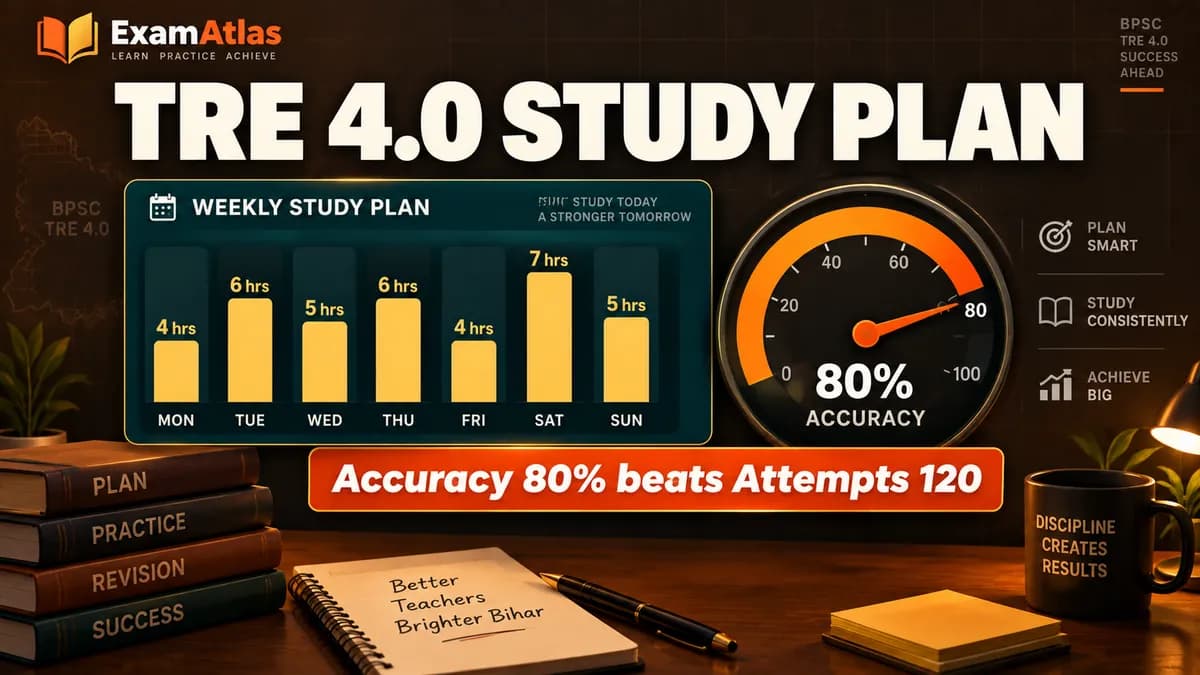
Take 120 merit questions. A candidate who attempts all 120 at 60% accuracy nets 56 marks. A candidate who attempts 90 at 80% accuracy and marks E on the remaining 30 nets 66 marks. The second candidate answered thirty fewer questions and finished ten marks ahead.
Look at the last row. High accuracy with a sensible attempt count beats everything else by a distance. So the training goal for the next eight weeks is not speed. It is knowing the difference between a question you can answer and a question you merely recognise.
A weekly structure that holds without a fixed exam date
Class 1-5 candidates, invert the first two rows. You have no subject paper, so all 120 merit marks come from General Studies, and your rotation has to cover eight areas: elementary mathematics, mental ability, general awareness, general science, social science, the Indian national movement, geography and environment.
The analysis block matters more than the mock itself. A mock you do not analyse is just an expensive way to feel bad on a Sunday.
How to analyse a mock under negative marking
- Count four numbers: correct, wrong, marked E, and left completely blank. The fourth number should always be zero.
- Split the wrong answers into two piles. Silly errors, where you knew the concept, and genuine gaps.
- For every genuine gap, write the chapter name, not the question. Chapters repeat; questions do not.
- Check your accuracy per section. If General Studies accuracy is below 65%, you are guessing there, and guessing now has a price.
- Revisit every question you marked E. If you knew it after all, your problem is confidence, not knowledge.
Do this for ten mocks and the pattern of where you lose marks will be obvious. Most candidates find that two or three chapters account for a third of their wrong answers.
Subject preparation: where the exam is actually won
At Class 6-8, 9-10 and 11-12, your subject paper carries 80 of the 120 merit marks and is also the first tie-breaker. Treat it accordingly.
The syllabus is tied to SCERT and NCERT in content, but the difficulty is set at the level of the minimum qualification for the post. For Class 11-12 that means post-graduation level, so reading only the NCERT textbooks and stopping is the mistake to avoid. Use NCERT for the content map and your post-graduate notes for depth. The full topic list is in our TRE 4.0 syllabus blog.
Social Science candidates at Class 6-8 and 9-10 have an extra step. If you pick History in Section-I you must pick Geography, Economics or Political Science in Section-II, and if you pick Geography you must pick Economics or Political Science. Fix that pair now, because it changes half your reading list.
General Studies: small daily sessions, not weekend marathons
General Studies at Class 6-8 and above is 40 marks across elementary mathematics, general awareness, general science, the Indian national movement and geography. That is five areas for 40 questions, so no single area deserves a full weekend.
Run a five-day rotation of about ninety minutes each. The Indian national movement is worth a little extra attention in a Bihar state recruitment, and the advertisement ties the General Studies paper to SCERT specifically, so start with Bihar SCERT books before moving to NCERT for the same chapters.
Language: clear 30% and move on
Part-I is English plus one of Hindi, Urdu or Bangla, and you need 9 marks out of 30. These marks never enter the merit list. Two hours a week of grammar and comprehension practice is enough for most candidates.
Do not confuse qualifying with negligible, though. Miss 30% here and your subject score becomes irrelevant. One weekly sitting, honestly done, closes this permanently.
Know your own qualifying bar
Note the EBC figure. Several websites print 36.5% for both BC and EBC, which is wrong for TRE 4.0. EBC is 34%. The 32% slab for women applies only to women who are permanent residents of Bihar.
And qualifying is only the entry ticket. With 16,101 posts at Class 11-12 and 3,847 at Class 1-5, the score that actually gets you selected is decided by competition, not by the qualifying line.
The OMR habit that is worth 6.67 marks
Every question you skip needs option E darkened. Skip 20 questions without marking E and you lose 6.67 marks for nothing.
Build the habit now. In every mock, fill E as you go rather than saving it for the last five minutes, because the last five minutes of a 150-question paper is exactly when a tired hand starts making mistakes. Four seconds per question, 80 seconds across 20 skips, and the marks stay yours.
A realistic eight-week block
- Weeks 1 to 2: finish the application first, then map your subject syllabus into strong and weak chapters. Two mocks, only to set a baseline.
- Weeks 3 to 5: weak chapters, one at a time, with same-day question practice. One mock a week, accuracy target 70%.
- Weeks 6 to 7: full-syllabus revision plus daily General Studies rotation. Two mocks a week, accuracy target 78%.
- Week 8 onwards: mocks and analysis only, with a short language sitting each week. Hold accuracy above 78% before pushing attempts back up.
An honest caveat: this block assumes your graduation or post-graduation subject knowledge is reasonably intact. If you last opened those books in 2019, add four weeks at the start and do not skip the chapter-wise practice.
FAQs
How should I prepare differently because of negative marking?
Train accuracy before speed. Track attempts and accuracy after every mock, keep accuracy above roughly 75% before increasing attempts, and mark option E on every question you skip.
How many hours a day are enough for TRE 4.0?
Four to five focused hours works for most working candidates, with about two-thirds going to the subject paper if you are at Class 6-8 or above. Consistency across the week beats a ten-hour Sunday.
Should I attempt all 150 questions?
Only if your accuracy supports it. At 60% accuracy, attempting everything nets less than attempting 90 questions at 80% accuracy. Mark E on the rest.
Is NCERT enough for the subject paper?
For content coverage yes, for depth no. The syllabus is SCERT and NCERT related, but the level follows the minimum qualification prescribed for the post, which is post-graduation for Class 11-12 and graduation for Class 9-10.
How many mock tests should I take?
One a week early on, two a week in the last month, with every mock followed by analysis that takes twice as long as the paper itself.
The exam date is not announced. Should I wait to start?
No. The application window closes on 26 October 2026 and all certificates must be issued by then. The exam date will come on bpsc.bihar.gov.in, and the candidates who benefit from an open timeline are the ones already studying when it arrives.
Do this before you open a book tomorrow
Finish the application. Complete your One Time Registration on bpsconline.bihar.gov.in, lock the profile, pay the Rs 100 fee, and submit before the last week of October. Our step-by-step application guide covers all six profile steps, including the live webcam photo and the signature in both Hindi and English.
Then take one full mock this week, with the E column filled and the 1/3 deduction applied, and write down your attempts and accuracy on the first page of your notebook. That pair of numbers is the only honest measure of progress you have until the result comes. The marking rules behind it are explained in our TRE 4.0 exam pattern guide.